Post

RISCHIO AMIANTO - ALLARME CONSUMATORI - TERMOS E CONTENITORI TERMICI

Immagine
Prodotti Pericolosi Ministero della Salute - Direzione generale della Prevenzione Aggiornamento allarme consumatori al 24 ottobre 2014 Link> Allarme Consumatori - Format Ministero - Termos Riferimenti fotografici (3 Foto): Link> Allarme Consumatori - Format Ministero - Termos

FDA USA - RECENT MEDICAL DEVICE RECALLS updated 11 20 2014

FDA posts consumer information about the most serious medical device recalls. These products are on the list because there is a reasonable chance that they could cause serious health problems or death. Use the yearly lists to find information about Class I medical device recalls and some Class II and III recalls of interest to consumers. The links give details about what to do if you own or use one of these products. Please note that FDA now lists medical device recall notices by the date that it posts the recall rather than the recall initiation date.  You can find the date that a firm initiated a recall in the text of the recall notice. Link>  Recent Medical Device Recalss Updated  11/20/14

Persistent effects after trigeminal nerve proprioceptive stimulation by mandibular extension on rat blood pressure, heart rate and pial microcirculation.

Immagine
Link to abstract> click here

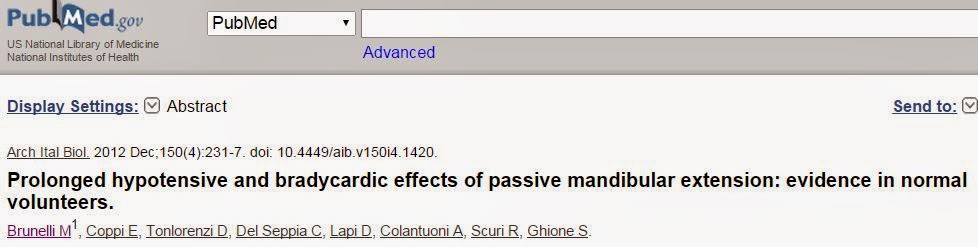
Prolonged hypotensive and bradycardic effects of passive mandibular extension: evidence in normal volunteers.

Immagine
Link to abstract> click here

2 THE TUBULAR VIAL FOR DENTAL SYRINGE

Immagine
Luca Martinelli The tubular vial for dental syringe Publication no. 2 - 31st October 2012 1. THE TUBULAR VIAL FOR DENTAL SYRINGE The tubular vial contains anaesthetic to perform local anaesthesia. They are intended for single use, more specifically for use on the same patient in the context of the same operation. The specific performance requirements for dental disposable cartridges, with a capacity of 1.8 ml and 2.2 ml, are given in the technical standard EN ISO 11499. 1.1 Main elements of the tubular vial 1.2 Identification of the type of anaesthetic   On the glass of tubular vial are then coloured identification bands which indicate the concentration of anaesthetic agent (Fig. 3, point 2) while the code indicates the concentration of vasoconstrictor (Fig. 3 point 3); the colour identifies the type of anaesthetic (e.g. Lidocaine, Mepivacaine, Prilocaine, Articaine, Bupivacaine) and its concentration (e.g. 2%, 3%, 4%, 0.5%), the absence or...